
The First Year · Feeding
First foods, joyfully messy.
Around six months, a whole new world opens up on a tiny spoon. Here's how to know she's ready, what to offer, and why the mess is part of the magic.
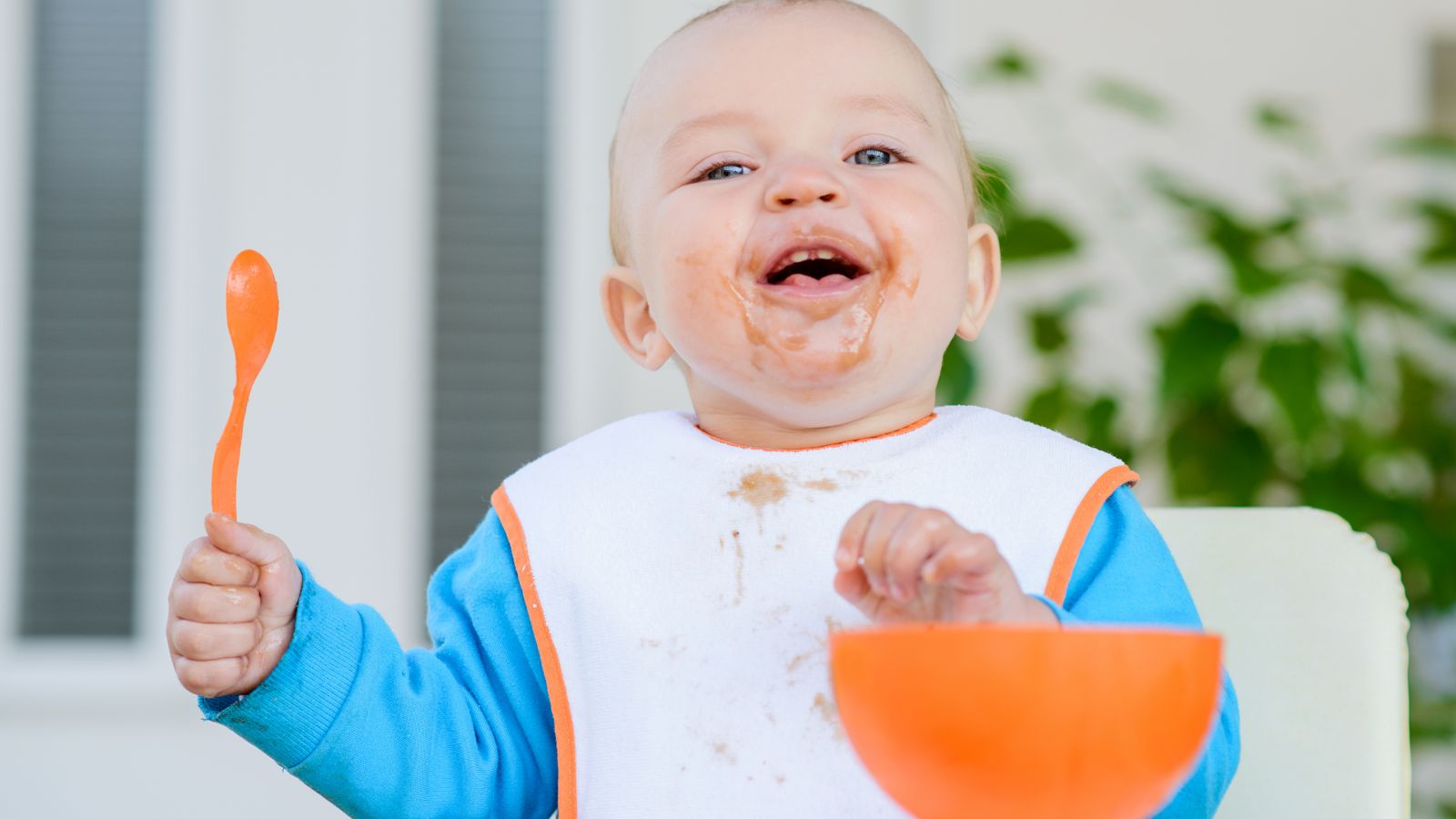
The first spoonful is a moment you'll never forget. Her eyes go wide, her nose wrinkles, a little bit of mashed sweet potato lands on her chin, and then she leans in for more. Or she doesn't, and that's funny, too. Either way, a lifetime of meals together has just begun.
Starting solids isn't a test to pass. It's a slow, happy introduction to taste, texture and the table. A few simple guidelines will carry you most of the way, and the rest is curiosity and patience.
When she's ready
Most babies are ready for their first foods at about six months. Starting before four months isn't recommended. If you're breastfeeding, the American Academy of Pediatrics recommends breast milk alone for about the first six months, then continuing to breastfeed as new foods come in.
Age is only part of it. Watch your baby, too. She may be ready when she:
- Sits up. On her own or with a little support.
- Holds her head steady. Good control of her head and neck.
- Opens her mouth for food. And reaches for what's on your plate.
- Swallows instead of pushing food out. She moves food to the back of her tongue.
- Brings things to her mouth. And grasps small objects.
The very first bites
Start small: half a spoonful or less, then work up to a teaspoon or two. First foods should be soft or pureed. Offer one single-ingredient food at a time and wait 3 to 5 days before adding another, so you can see how she does with each one.
Foods rich in iron and zinc are a great early choice, such as meat-based purees or iron-fortified cereals. Mix it up with a variety of fortified cereals like oat, barley and multigrain, rather than rice cereal alone. Cook fresh foods without added salt or seasoning. Mashed banana is an easy, no-cook favorite.
From smooth to finger foods
Once she can sit up and bring objects to her mouth, soft finger foods cut into small pieces are a joy to watch her discover. Think banana, scrambled eggs, well-cooked pasta, or cooked potatoes and peas. Foods that dissolve easily in her mouth and don't need much chewing are just right for gums still learning.
Serve small portions, let her go slowly, and always stay with her while she eats.
Say yes to the common allergens
Here's some happy news for parents: you don't need to hold back common allergens. Foods like peanut, egg, dairy and sesame can be introduced starting around six months, alongside her other first foods. Waiting longer doesn't prevent food allergies and may actually raise the risk.
Introduce them the same way as everything else: a small amount, one new food at a time. Whole peanuts and chunks of peanut butter stay off the menu, since they're choking hazards.
If your baby has severe eczema or an egg allergy, or your family has a history of allergies, check with your pediatrician first. She may recommend testing or a plan for introducing peanut safely.
What waits until her first birthday
Honey. Not even a taste before age one, including honey on pacifiers. It can carry the bacteria that cause botulism. Cow's milk as a drink. Save it for after 12 months. Plain yogurt without added sugar is fine before then. Juice. None before 12 months. Choking hazards. Skip whole grapes, nuts and seeds, popcorn, hot dogs, chunks of meat or cheese, raw vegetables, hard fruit chunks like apple, chunks of peanut butter, and hard or sticky candy. Cut grapes, cherries, berries and cherry tomatoes into small pieces, and mash or cook hard fruits and vegetables.
Let her make a glorious mess
Avocado in her eyebrows. Yogurt fingerprints on the tray. Peas on the floor, peas in her hair, one triumphant pea in her mouth. This is exactly how it should look.
Squishing, smearing and dropping are how she learns what food is. Let her touch it, explore it and feed herself when she's ready. Put a washable mat under the high chair, roll up her sleeves, and keep your camera close. Some days she'll eat a lot and some days she'll eat almost nothing. At this age, breast milk or formula is still doing the heavy lifting, so you can relax and enjoy the show.
She'll also tell you when she's done. Turning her head away or closing her lips are her polite (or not so polite) way of saying "no more, thank you."
A seat at the family table
Pull her high chair right up to the table. She's watching how you chew, how you sip, how you laugh between bites. Eating together, even when her dinner is three pieces of soft carrot, teaches her that meals are a time for connection.
Talk to her about what she's tasting. Name the colors. Let her see you enjoy your vegetables. These small, shared moments, repeated day after day, are how good habits quietly take root.
If you notice a reaction after a new food, or you have any questions about how and when to start, call your pediatrician. She knows your baby and is happy to help. If she ever has trouble breathing or swelling of her lips, tongue or face after eating, call 911.
Bon appétit, little one. Here's to a lifetime of sweet, messy, wonderful meals together.
Track every new taste on the way to 100.
Where this comes from
This article draws on guidance from the American Academy of Pediatrics and the Centers for Disease Control and Prevention. It's here to help, not to replace your own doctor, midwife or pediatrician. If you have questions, ask them.
- When Can Babies Start Solid Foods? Readiness & Feeding Tips, American Academy of Pediatrics (HealthyChildren.org)
- When, What, and How to Introduce Solid Foods, Centers for Disease Control and Prevention
- Food Allergies in Children: Causes, Symptoms, Diagnosis & Treatment, American Academy of Pediatrics (HealthyChildren.org)
- AAP Clinical Report Highlights Early Introduction of Peanut-Based Foods to Prevent Allergies, American Academy of Pediatrics
- Botulism Prevention, Centers for Disease Control and Prevention