
The First Year · Milestones
The crawl is coming.
First she lifts her head, then she rocks, then one day she's halfway across the rug. Here's how crawling unfolds, why some babies skip it, and how to cheer her on.
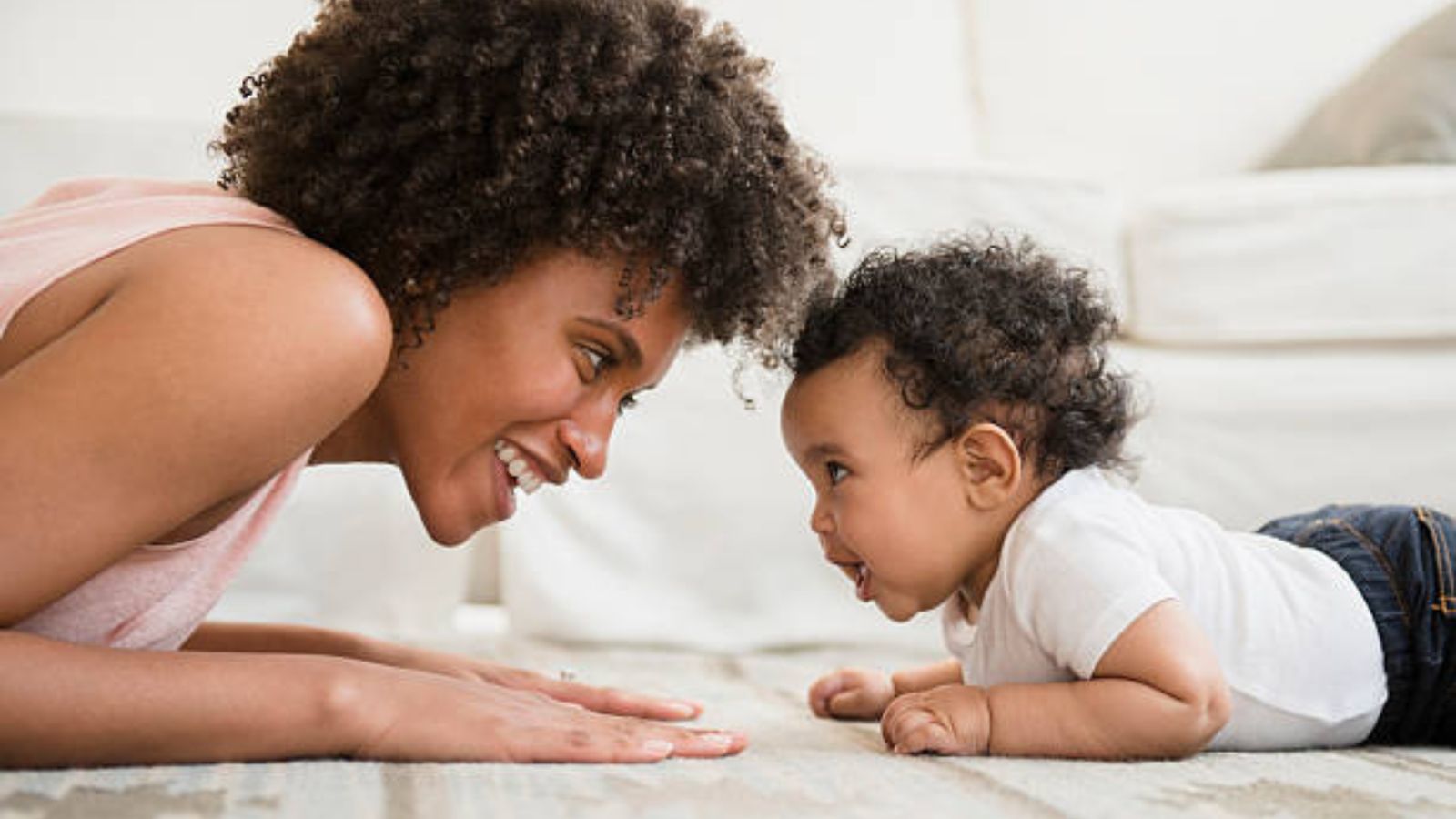
You set her down on the play mat, turn around for one second, and when you look back she's somewhere else. Not far. Just a few inches closer to the toy she's been staring at. She looks up at you, very pleased with herself. The world has just gotten a whole lot bigger.
Crawling is one of the most fun stages to watch, because it doesn't happen all at once. It builds slowly, one wobbly, determined push at a time, and every baby takes her own route to get there.
It starts on her tummy
Long before she crawls, she's getting ready during tummy time. The American Academy of Pediatrics suggests starting the day you bring her home, 2 to 3 times a day for 3 to 5 minutes. As she grows to enjoy it, you can work up to 15 to 30 minutes a day by 7 weeks.
Those little sessions build the strong neck, shoulder and arm muscles she'll need to slide on her belly and, eventually, crawl. Lie down face to face with her, or let her rest on your chest so she can lift her head to look at you.
By 6 months, most babies push up with straight arms on their tummy, roll from tummy to back, and lean on their hands to hold themselves up while sitting.
The fun stages before the crawl
Somewhere between 6 and 9 months, the moving really begins. Many babies first pull themselves along with their arms alone, belly on the floor, then figure out how to bring their legs into it. You may also see:
- Rocking on hands and knees. She gets up in position and sways back and forth, as if revving her engine.
- Going backward. Her arms are stronger than her legs at this stage, so she may push herself in reverse at first. It's normal, and it's adorable.
- Scooting. Some babies shuffle along on their bottoms.
- Slithering. Others glide on their stomachs to get where they want to go.
Crawling is usually mastered between 7 and 10 months. By 9 to 12 months, she may crawl from a sitting position and use her new speed to escape diaper changes.
Some babies skip it
Here's something that surprises a lot of parents: a few babies never crawl at all. They scoot, slither or roll their way around, and then pull up to stand.
The CDC's milestone checklists don't list crawling as a milestone at 6 months, 9 months or 1 year. Those checklists focus on things most babies (75% or more) do by each age. By 9 months, that includes sitting without support and getting into a sitting position on her own. By 1 year, it includes pulling up to stand and walking while holding on to furniture.
The thing to remember
How she gets around matters less than the fact that she's moving and exploring. If she uses both sides of her body, and each arm and leg, about equally, that's a great sign.
Play that cheers her on
You don't need anything fancy to encourage her. Floor time and your company are the best tools there are.
- Put a favorite toy just out of reach. Let her stretch, roll, scoot or crawl to get it.
- Make a circle of toys. Reaching in different directions builds the muscles she uses to roll, scoot and crawl.
- Build a soft obstacle course. Pillows, boxes and sofa cushions make a fun little adventure. Stay right with her, since a baby can get stuck between pillows or under a box.
- Get down on the floor. Play together on a play mat every day. Your face is still her favorite thing to crawl toward.
Ready for a baby on the move
Once she's mobile, take a look at your home from her level. A few calm steps go a long way:
- Clear the floor of small things. Especially button batteries, coins and bits of popped balloons.
- Gate the stairs. At the top and the bottom.
- Move sharp or breakable things up high. And lock away medicines and cleaning products.
- Save the Poison Help number. It's 800-222-1222.
Skip baby walkers. The American Academy of Pediatrics strongly urges parents not to use them, since babies in walkers can tip over and roll down stairs. When she's ready to practice walking, let her push a sturdy empty box or push toy, or hold your hands.
Off she goes
The day she crawls all the way across the room to you, arms reaching, face beaming, is one you'll remember. She's not just moving. She's choosing where she wants to go, and so often, it's you.
When to check in
If you feel she isn't moving the way she should, or you notice she favors one side of her body, talk with her pediatrician. You don't need to wait for the next visit. Share what you've seen and ask about developmental screening. You know your baby best, and your instincts are worth listening to.
Here she comes, Mama. Get down on the floor and open your arms.
The date and the story of every first, ready to print.
Where this comes from
This article draws on guidance from the American Academy of Pediatrics and the Centers for Disease Control and Prevention. It's here to help, not to replace your own doctor, midwife or pediatrician. If you have questions, ask them.
- Movement Milestones in Babies 8 to 12 Months Old, American Academy of Pediatrics (HealthyChildren.org)
- Back to Sleep, Tummy to Play: Give Your Baby a Safe, Strong Start, American Academy of Pediatrics (HealthyChildren.org)
- How Active is Your Baby? Tips to Get Infants Learning, Moving & Thriving, American Academy of Pediatrics (HealthyChildren.org)
- Milestones by 6 Months, Centers for Disease Control and Prevention
- Milestones by 9 Months, Centers for Disease Control and Prevention
- Milestones by 1 Year, Centers for Disease Control and Prevention